Soybean is a globally important oil and grain crop, yet drought stress causes up to 40% yield losses annually. With intensifying climate change, the development of drought-tolerant soybean varieties has become an urgent necessity for ensuring food security. In response to drought stress, plants employ a multi-layered defense system including stomatal closure, accumulation of osmotic regulators, and scavenging of reactive oxygen species (ROS). Behind these physiological responses, transcription factors act as "master switches," precisely orchestrating the expression networks of numerous downstream genes. Elucidating the interaction patterns among transcription factors holds significant breeding value for overcoming the limitations of single-gene utilization and advancing multi-gene synergistic approaches to enhance soybean drought tolerance. However, systematic understanding of how transcription factors cooperate through synergistic interactions to amplify defense signals and enhance drought tolerance in soybean has remained lacking.
Recently, a research team led by Prof. ZHAI Hong from the Laboratory of Soybean Molecular Breeding, Northeast Institute of Geography and Agroecology, Chinese Academy of Science (CAS) revealed that soybean GmWRKY20 and GmbZIP9 constitute a transcriptional module to co-activate GmANKTM21, clarifying their function and molecular basis for soybean drought tolerance.
This work was published in Plant Physiology on June 24.
Previously, the team identified the drought tolerance gene GsWRKY20 from wild soybean (Glycine soja). Building on this work, GmWRKY20 knockout mutants were generated in cultivated soybean using CRISPR/Cas9 gene-editing technology. Knockout of GmWRKY20 significantly reduced drought tolerance, establishing GmWRKY20 as a key positive regulator of drought resistance in soybean. Through yeast two-hybrid screening, its interacting protein GmbZIP9 was identified. Independent overexpression of GmbZIP9 enhanced ROS scavenging capacity and drought tolerance in soybean. Co-expression of GmWRKY20 and GmbZIP9 produced a significant synergistic effect, markedly improving plant survival rates under drought stress (Figure 1). Epistasis analysis further revealed that the function of GmbZIP9 depends on the presence of GmWRKY20. The GmANKTM21 gene (encoding a plasma membrane-anchored protein) was identified as a direct downstream target of the GmWRKY20-GmbZIP9 complex. The heterodimer formed by GmWRKY20 and GmbZIP9 exhibited a super-additive enhancement in transcriptional activation capacity, driving a substantial upregulation of GmANKTM21 transcription.
The findings reveal the cooperative molecular mechanism between WRKY and bZIP transcription factors in soybean, breaking through the traditional single-gene breeding paradigm. By pyramiding superior alleles of GmWRKY20 and GmbZIP9, it is expected that soybean germplasm with significantly enhanced drought tolerance could be developed, providing strong scientific and technological support to address the food security challenges posed by climate change.
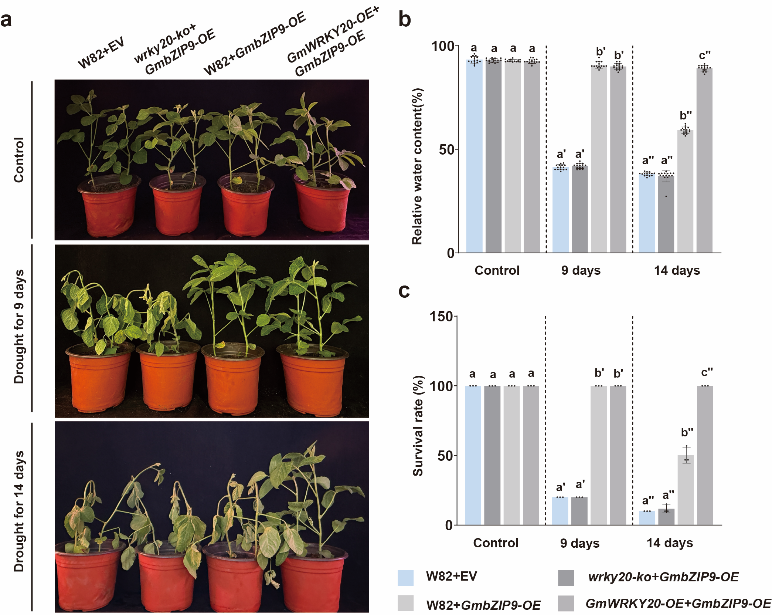
Figure 1. Co-expression of GmWRKY20 and GmbZIP9 synergistically enhances drought tolerance in soybean plants.
(Image by JIAOShuang)
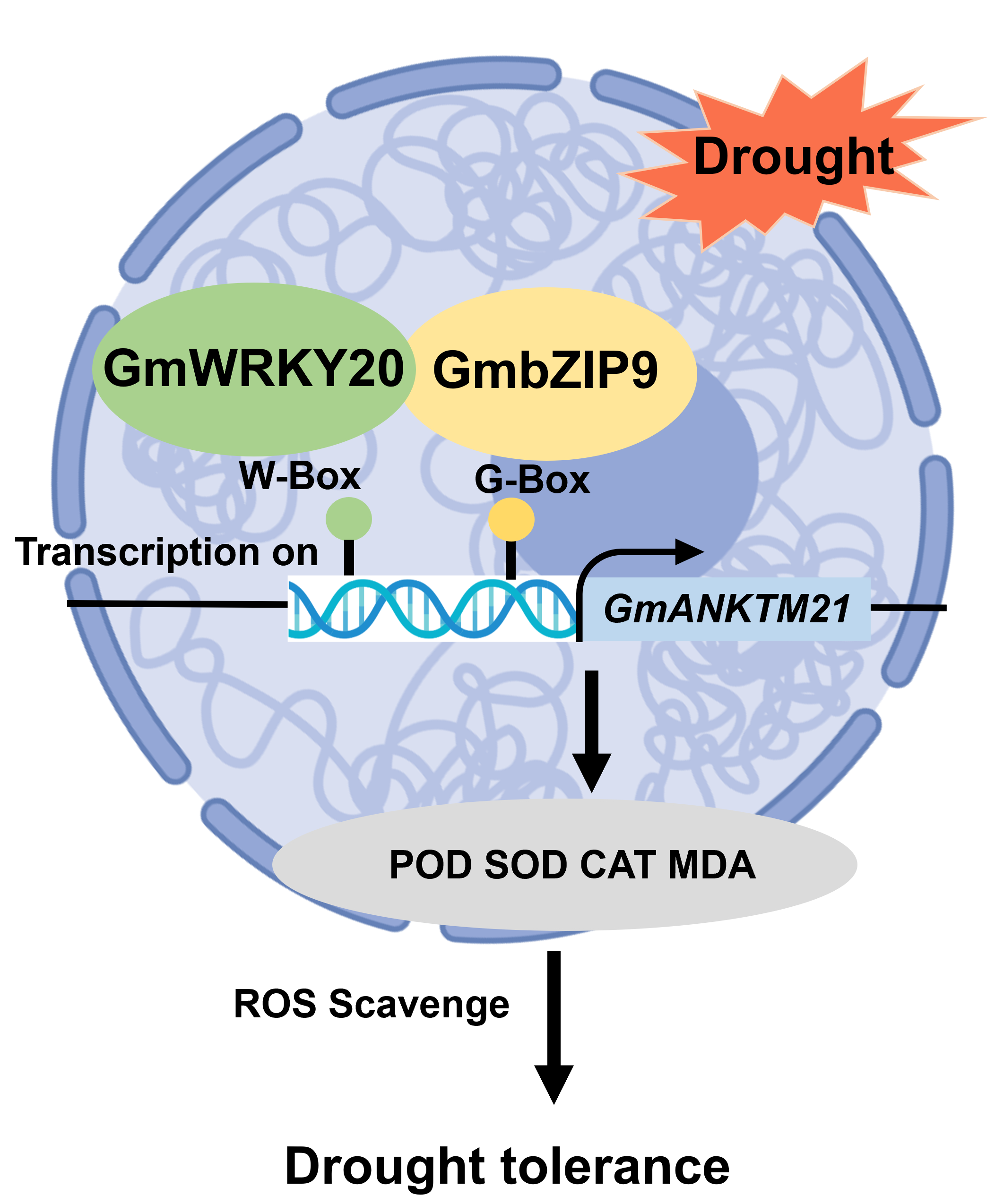
Figure 2. Molecular mechanism model for synergistic control of soybean drought tolerance by GmWRKY20 and GmbZIP9.
(Image by JIAOShuang)
Contact:
Hong Zhai
Northeast Institute of Geography and Agroecology, Chinese Academy of Sciences
E-mail: zhaih@iga.ac.cn
Reference:
Shuang Jiao, Ke Zhao, Xiaohong Liu, Jianing Zhao, Rui Zhao, Yanting Dong, Longji Shan, Jianing Zhao, Huibing Mu, Dandan Guo, Huaiyuan Qi, Jingwen Zhou, Baohui Liu*, Xi Bai*, Hong Zhai*. A GmWRKY20–GmbZIP9 transcriptional module synergistically activates GmANKTM21 to confer drought tolerance in soybean. Plant Physiology, 2026. doi: https://doi.org/10.1093/plphys/kiag421.
https://doi.org/10.1093/plphys/kiag421.